
Thank you for Subscribing to Medical Care Review Weekly Brief


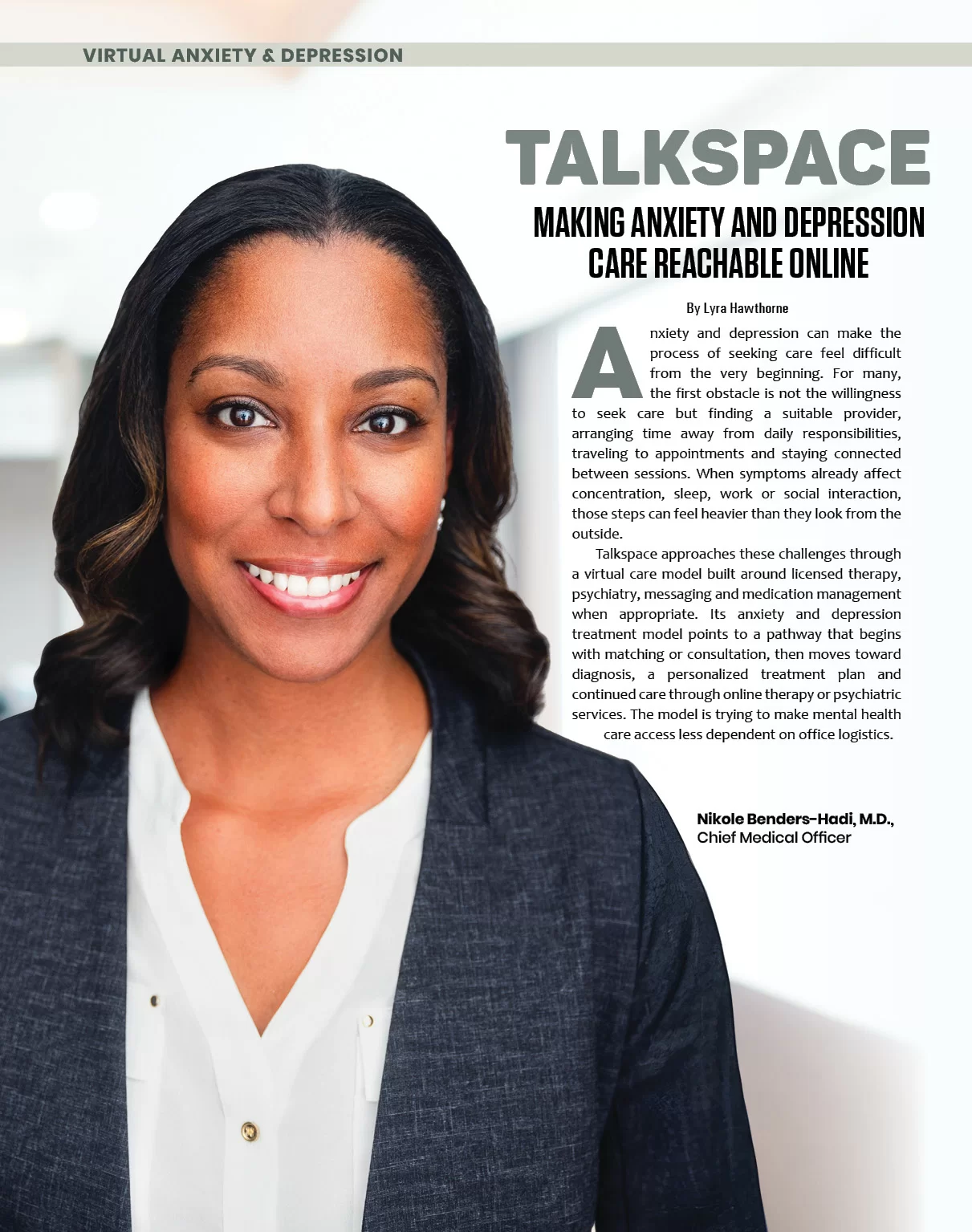
 Nikole Benders-Hadi, M.D. Chief Medical Officer
Anxiety and depression can make the process of seeking care feel difficult from the very beginning. For many, the first obstacle is not the willingness to seek care but finding a suitable provider, arranging time away from daily responsibilities, traveling to appointments and staying connected between sessions. When symptoms already affect concentration, sleep, work or social interaction, those steps can feel heavier than they look from the outside.
Talkspace approaches these challenges through a virtual care model built around licensed therapy, psychiatry, messaging and medication management when appropriate. Its anxiety and depression treatment model points to a pathway that begins with matching or consultation, then moves toward diagnosis, a personalized treatment plan and continued care through online therapy or psychiatric services. The model is trying to make mental health care access less dependent on office logistics.
That distinction is important for virtual anxiety and depression treatment.
The value of online care does not come from moving a conversation to a screen. It comes from reducing the distance between symptom recognition, provider connection and ongoing treatment. For people managing generalized anxiety, social anxiety or depression, that continuity can matter as much as the first appointment.
“Being recognized by Medical Care Review validates Talkspace’s core mission: making high-quality mental healthcare accessible to everyone, especially those facing anxiety and depression. Our deep foundation of clinical data drives our product innovation and equips clinicians with the tools for early symptom identification. This allows us to more accurately diagnose, efficiently connect members to support, and ultimately help them reclaim their lives,” says Nikole Benders-Hadi, M.D. Chief Medical Officer.
Reducing Barriers and Building Continuity
A traditional care journey often begins with a search: finding a therapist, confirming availability, arranging transportation and waiting for a suitable opening. Talkspace’s online therapy compresses that by matching members with licensed providers and offering therapy through video sessions, voice sessions, live chat and messaging.
The practical effect is simple. A person seeking care can begin at home, choose a communication format that fits the moment, and continue contact beyond the narrow frame of a scheduled appointment. This does not remove the seriousness of treatment. It changes the access point.
For anxiety, that matters because symptoms can make travel, waiting rooms or unfamiliar settings harder to manage. For depression, the effort needed to arrange care can itself become a barrier. A virtual model cannot solve every barrier, but it can remove some of the friction that delays care.
Our deep foundation of clinical data drives our product innovation and equips clinicians with the tools for early symptom identification. This allows us to more accurately diagnose, efficiently connect members to support, and ultimately help them reclaim their lives.
Mental health treatment often happens in the space between appointments. Thoughts return after the session ends. Anxiety spikes before a stressful work meeting or difficult social interaction. Depressive symptoms may deepen at night, during work or after a difficult interaction. A care model built only around scheduled conversations can leave long gaps.
Talkspace’s messaging format addresses that gap by allowing members to send text, audio or video messages to their therapist. This creates a different rhythm for therapy. A person can record what they are experiencing closer to the moment it happens, rather than trying to reconstruct it days later. The clinical work still belongs to licensed providers and technology creates a channel for continuity. Live sessions offer the concentrated space of therapy, while messaging keeps care connected to daily life. For anxiety and depression treatment, that connection can help providers understand patterns more clearly through recurring worries, avoidance behaviors, mood shifts, triggers and coping attempts.
This is where the platform’s virtual design becomes more than convenience. It gives treatment a longer line of sight into daily patterns and emotional changes without making care dependent on constant live contact.
Matching Treatment to Anxiety and Depression
Talkspace’s approach to anxiety and depression treatment is an ongoing process rather than a one-time interaction. Once a person begins by discussing symptoms with a licensed therapist or psychiatric provider, the provider may determine a diagnosis if appropriate and develop a treatment plan that can include online therapy, psychiatry or medication management. For generalized anxiety disorder, the care pathway centers on persistent worry and its effect on daily life. For social anxiety, the focus shifts toward fear and avoidance in social situations. Depression brings a different set of concerns, often involving mood, energy, sleep, motivation and daily functioning. These are not interchangeable experiences, even when they overlap.
Talkspace’s approach is strongest when viewed as a treatment pathway, not simply an online therapy brand. Anxiety and depression care often requires adjustment over time. Some members may need therapy alone and others may need a psychiatric evaluation. Some may move between therapy and medication management as symptoms, response and provider recommendations change.
A virtual provider model gives that pathway more flexibility. The care can begin through therapy, expand into psychiatry when appropriate and continue through online communication without forcing the person to restart the process in a separate system.
Talkspace understands that not every anxiety or depression case requires medication. Its psychiatry service gives members access to psychiatric providers who can identify symptoms, provide a diagnosis and develop a treatment plan that may include prescription medication when appropriate. Medication decisions remain clinical decisions, not platform features. The important aspect is that Talkspace connects therapy and psychiatry within the same broader virtual care environment. A member who needs psychiatric evaluation does not have to treat medication management as an entirely separate search.
Talkspace provides care through live video sessions with licensed mental health professionals. It also includes ongoing care and medication management, including follow-up appointments. For people with anxiety or depression that ongoing structure matters because treatment is rarely settled in a single conversation. Dosage, response, side effects and symptom changes require review.
A virtual psychiatry pathway can make that process more reachable. It also gives Talkspace a stronger position in anxiety and depression treatment, because the model covers both therapeutic conversation and medical evaluation, where clinically appropriate.
A Practical Model for Earlier Connection Without Overpromising
Talkspace’s broader value lies not only in offering therapy online. It creates more entry points into treatment through matching, symptom discussion, diagnosis, therapy, psychiatry and medication management.
That matters because anxiety and depression often go untreated or under-treated when people delay reaching out. The delay may come from cost, availability, discomfort, stigma or the simple difficulty of arranging care while symptoms are active. A virtual model cannot eliminate all of those pressures, but it can shorten the route between recognizing a problem and speaking with a licensed provider. Talkspace’s use of digital access, provider matching and condition-specific pathways helps turn that route into a clearer process. The person does not have to know in advance whether therapy, psychiatry or medication management will be the right fit. The care path can begin with a conversation and become more specific from there.
Virtual anxiety and depression treatment is also important. It is not a cure-all, and it should not be framed as one. People experience symptoms differently, and care needs can change. Some situations may require in-person care, urgent intervention or additional clinical resources.
Talkspace’s model is strongest when understood as a practical care channel. It gives members a way to connect with licensed providers, communicate between sessions, receive therapy in flexible formats and access psychiatric care when medication evaluation is appropriate. That combination makes treatment easier to begin and easier to continue.
Talkspace has positioned itself as one of the strongest leaders in digital mental health care by combining licensed therapy, psychiatry, messaging and medication management into a single accessible platform. Its model directly addresses the barriers that prevent many people from seeking consistent care, including scheduling limitations, geographic access and cost-related friction. Rather than offering a lighter version of treatment, it has built a scalable system designed to make clinically grounded mental health support more available to people who might otherwise go without it. As virtual care continues to reshape healthcare delivery, Talkspace stands out as a company helping define what modern mental health access looks like.
What Do Virtual Anxiety and Depression Treatment Providers Help People Access?
Virtual Anxiety and Depression Treatment Providers make mental health support easier to begin by moving assessment, therapy conversations and ongoing communication into an online care environment. The category is especially relevant when anxiety or depression makes travel, scheduling or waiting for appointments feel difficult. Effective providers focus on clinical fit, continuity and clear pathways, not just convenience. The goal is to connect users with licensed care in a format that can support consistent participation.
How Does Talkspace Support Online Anxiety and Depression Care?
Talkspace shows how Virtual Anxiety and Depression Treatment Providers can combine access and clinical structure. It offers online therapy, psychiatry, provider matching, messaging and medication management when clinically appropriate. Members can use live video, voice, chat and asynchronous messaging, allowing care to fit different communication needs. Its model also supports therapist switching when the relationship is not the right fit, a practical detail because trust often shapes whether treatment continues.
What Services Are Common in This Type of Virtual Treatment?
Virtual Anxiety and Depression Treatment Providers may include therapy sessions, psychiatric evaluation, diagnosis support, personalized treatment planning and follow-up care. Some users may benefit from therapy alone, while others may need psychiatry or medication review. The best models keep those options connected so users do not have to restart their search when needs change. For anxiety and depression, that continuity can help providers understand symptoms, patterns and treatment response over time.
Why Does Ongoing Messaging Matter in Virtual Mental Health Care?
Messaging gives Virtual Anxiety and Depression Treatment Providers a way to keep care connected between scheduled sessions. Anxiety spikes, avoidance patterns, mood changes and sleep problems often appear outside a single appointment window. Text, audio or video messages can help users describe experiences closer to the moment they happen. This does not replace clinical judgment, but it can give providers more context and make therapy feel less isolated from daily life.
What Should Users Look for When Evaluating Providers?
Users evaluating Virtual Anxiety and Depression Treatment Providers should look for licensed professionals, a clear clinical care pathway, flexible communication formats, privacy practices and options for follow-up. It also matters whether therapy and psychiatry can work together when medication evaluation is appropriate. The strongest models avoid treating virtual care as a lighter version of treatment. Evaluation should also consider whether users can maintain contact after an initial visit without navigating separate systems or repeated intake steps.
How Does Talkspace Reflect the Direction of Virtual Mental Health Treatment?
Talkspace reflects how Virtual Anxiety and Depression Treatment Providers are expanding access while keeping treatment grounded in licensed care. Its pathway can begin with symptom discussion and matching, continue through therapy, diagnosis, psychiatry or medication management when appropriate. The platform also supports messages between sessions, giving providers a longer view of daily symptoms and coping attempts. That combination positions virtual treatment as a practical care channel rather than a one-time online appointment.
