Thank you for Subscribing to Medical Care Review Weekly Brief


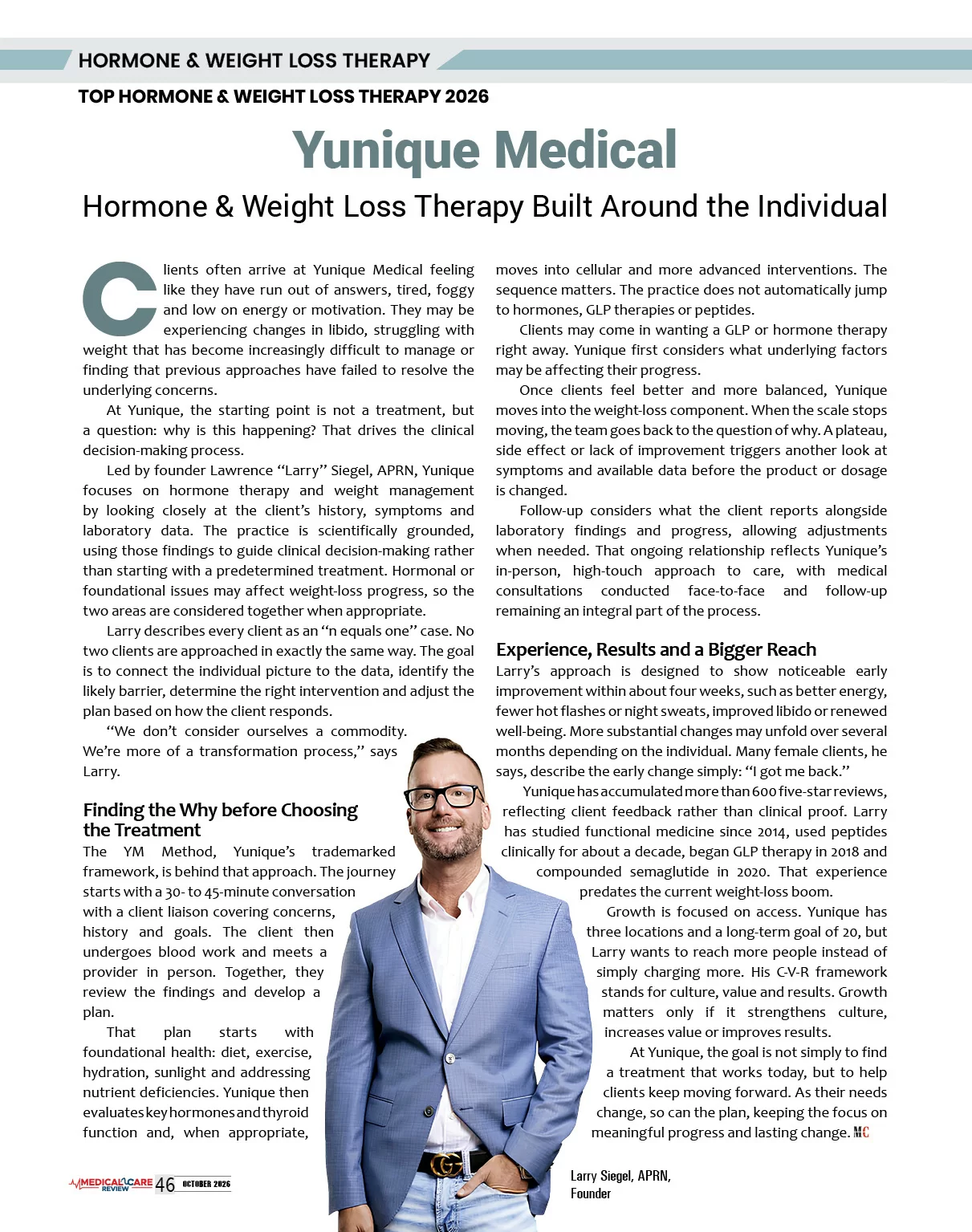
 Larry Siegel, APRN, Founder
Clients often arrive at Yunique Medical feeling like they have run out of answers, tired, foggy and low on energy or motivation. They may be experiencing changes in libido, struggling with weight that has become increasingly difficult to manage or finding that previous approaches have failed to resolve the underlying concerns.
At Yunique, the starting point is not a treatment, but a question: why is this happening? That drives the clinical decision-making process.
Led by founder Lawrence “Larry” Siegel, APRN, Yunique focuses on hormone therapy and weight management by looking closely at the client’s history, symptoms and laboratory data. The practice is scientifically grounded, using those findings to guide clinical decision-making rather than starting with a predetermined treatment. Hormonal or foundational issues may affect weight-loss progress, so the two areas are considered together when appropriate.
Larry describes every client as an “n equals one” case. No two clients are approached in exactly the same way. The goal is to connect the individual picture to the data, identify the likely barrier, determine the right intervention and adjust the plan based on how the client responds.
“We don’t consider ourselves a commodity. We’re more of a transformation process,” says Larry.
Finding the Why before Choosing the Treatment
The YM Method, Yunique’s trademarked framework, is behind that approach. The journey starts with a 30- to 45-minute conversation with a client liaison covering concerns, history and goals. The client then undergoes blood work and meets a provider in person. Together, they review the findings and develop a plan.
That plan starts with foundational health: diet, exercise, hydration, sunlight and addressing nutrient deficiencies. Yunique then evaluates key hormones and thyroid function and, when appropriate, moves into cellular and more advanced interventions. The sequence matters. The practice does not automatically jump to hormones, GLP therapies or peptides.
Clients may come in wanting a GLP or hormone therapy right away. Yunique first considers what underlying factors may be affecting their progress.
Once clients feel better and more balanced, Yunique moves into the weight-loss component. When the scale stops moving, the team goes back to the question of why. A plateau, side effect or lack of improvement triggers another look at symptoms and available data before the product or dosage is changed.
Follow-up considers what the client reports alongside laboratory findings and progress, allowing adjustments when needed. That ongoing relationship reflects Yunique’s in-person, high-touch approach to care, with medical consultations conducted face-to-face and follow-up remaining an integral part of the process.
Experience, Results and a Bigger Reach
Larry’s approach is designed to show noticeable early improvement within about four weeks, such as better energy, fewer hot flashes or night sweats, improved libido or renewed well-being. More substantial changes may unfold over several months depending on the individual. Many female clients, he says, describe the early change simply: “I got me back.”
Yunique has accumulated more than 600 five-star reviews, reflecting client feedback rather than clinical proof. Larry has studied functional medicine since 2014, used peptides clinically for about a decade, began GLP therapy in 2018 and compounded semaglutide in 2020. That experience predates the current weight-loss boom.
Growth is focused on access. Yunique has three locations and a long-term goal of 20, but Larry wants to reach more people instead of simply charging more. His C-V-R framework stands for culture, value and results. Growth matters only if it strengthens culture, increases value or improves results.
At Yunique, the goal is not simply to find a treatment that works today, but to help clients keep moving forward. As their needs change, so can the plan, keeping the focus on meaningful progress and lasting change.
What Does Hormone & Weight Loss Therapy Typically Address?
Hormone & Weight Loss Therapy can address concerns that may overlap, including changes in energy, libido, body composition, weight management and overall well-being. Rather than assuming every concern has a single cause, a thorough approach considers symptoms, health history and relevant laboratory findings together. Hormonal changes, thyroid function, lifestyle factors and other foundational health issues can all affect how an individual feels and responds to a weight-management plan. The goal is to understand the broader picture before deciding which intervention may be appropriate.
How Does Yunique Medical Approach Hormone & Weight Loss Therapy?
Yunique Medical approaches Hormone & Weight Loss Therapy by first asking why a client is experiencing a particular concern. Its process considers the individual's history, symptoms and laboratory data before a treatment plan is developed. Through its trademarked YM Method, the practice begins with an extended conversation about concerns, history and goals, followed by blood work and an in-person provider consultation. Yunique Medical also addresses foundational areas such as diet, exercise, hydration, sunlight and nutrient deficiencies before determining whether further hormonal, weight-management or other interventions are appropriate.
Why Is It Important to Look Beyond the Scale in Weight Management?
Effective Hormone & Weight Loss Therapy should not rely on weight alone as the measure of progress. Changes in energy, sleep, symptoms, well-being and other health indicators may provide important context alongside the scale. When progress slows, it can be useful to reassess what may be contributing to the plateau rather than automatically changing a product or dosage. A more responsive weight-management process considers how the individual is feeling, what the available data shows and whether the original plan still fits the person's current needs.
What Factors Should Be Evaluated Before Starting a Hormone or Weight-Loss Treatment?
Hormone & Weight Loss Therapy benefits from a careful evaluation before treatment decisions are made. Relevant considerations can include symptoms, medical history, laboratory findings, lifestyle habits and foundational health factors. Depending on the individual, hormone levels and thyroid function may also require evaluation. This approach helps avoid beginning with a predetermined solution simply because a client arrives requesting a particular therapy. A well-structured care process should instead identify the factors most relevant to the individual's situation and determine what sequence of interventions may be appropriate.
How Does Follow-Up Support Hormone & Weight Loss Therapy Over Time?
Follow-up is an important part of Hormone & Weight Loss Therapy because an individual's response can change over time. Progress, symptoms, side effects and laboratory findings can provide new information that affects the next clinical decision. Yunique Medical uses ongoing, in-person follow-up as part of its high-touch model, reviewing client-reported changes alongside available data. If weight loss stalls, symptoms persist or a side effect emerges, the practice returns to the underlying question of what may be affecting progress before making adjustments to the plan.
Can Hormone and Weight-Management Needs Change During Treatment?
Yes. Hormone & Weight Loss Therapy is not necessarily a fixed process because the needs and responses of individuals can change. A plan that is appropriate at one stage may need adjustment as symptoms improve, goals evolve or new information becomes available. Yunique Medical's approach reflects this individualized model by treating each case as distinct rather than applying the same sequence to everyone. Its clinical process also separates foundational health work from more advanced interventions, allowing treatment decisions to develop according to the individual's progress.
