
Thank you for Subscribing to Medical Care Review Weekly Brief


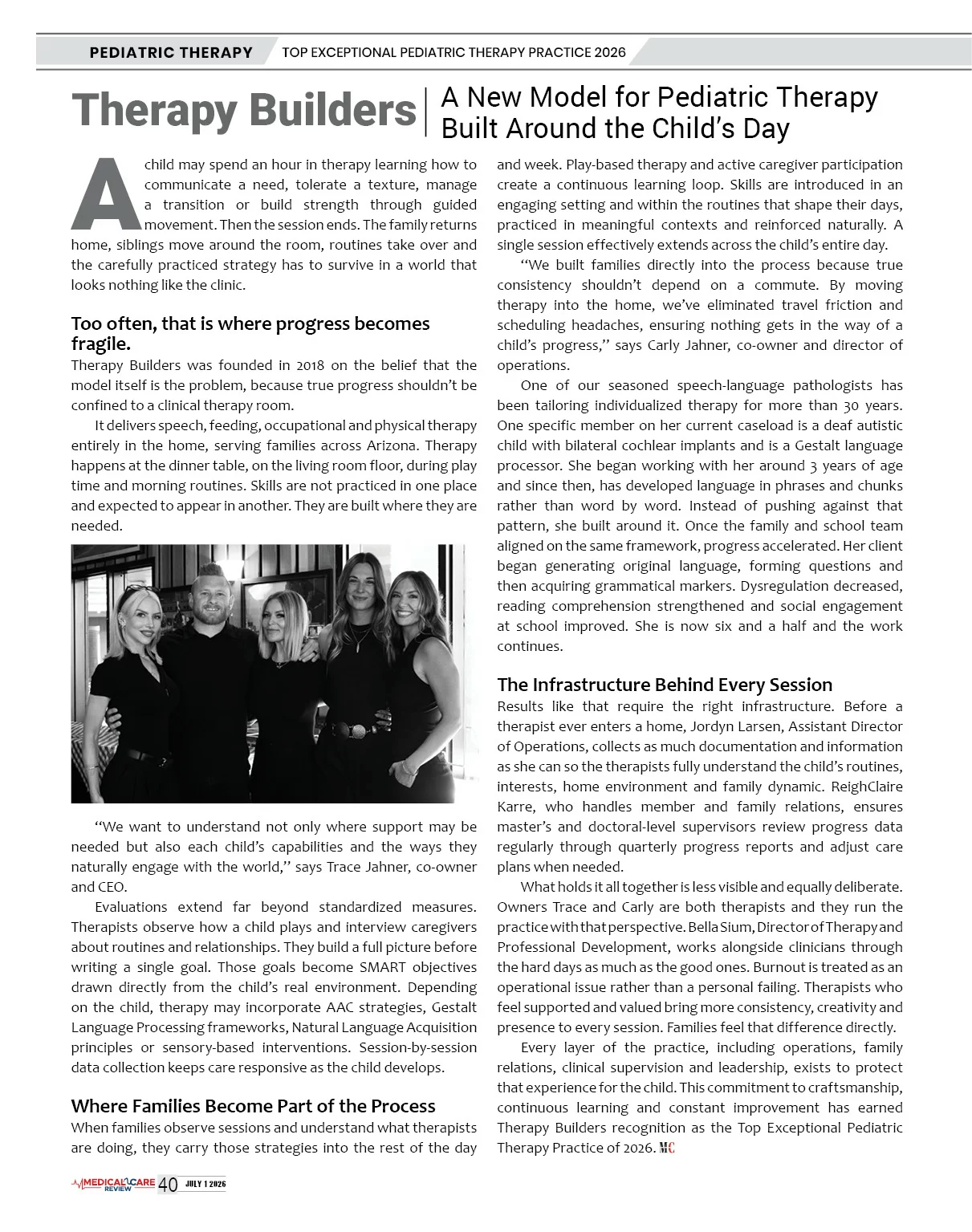
 Trace Jahner, Owner and CEO
A child may spend an hour in therapy learning how to communicate a need, tolerate a texture, manage a transition or build strength through guided movement. Then the session ends. The family returns home, siblings move around the room, routines take over and the carefully practiced strategy has to survive in a world that looks nothing like the clinic.
Too often, that is where progress becomes fragile.
Therapy Builders was founded in 2018 on the belief that the model itself is the problem, because true progress shouldn’t be confined to a clinical therapy room.
It delivers speech, feeding, occupational and physical therapy entirely in the home, serving families across Arizona. Therapy happens at the dinner table, on the living room floor, during play time and morning routines. Skills are not practiced in one place and expected to appear in another. They are built where they are needed.
“We want to understand not only where support may be needed but also each child’s capabilities and the ways they naturally engage with the world,” says Trace Jahner, co-owner and CEO.
Evaluations extend far beyond standardized measures. Therapists observe how a child plays and interview caregivers about routines and relationships. They build a full picture before writing a single goal. Those goals become SMART objectives drawn directly from the child’s real environment. Depending on the child, therapy may incorporate AAC strategies, Gestalt Language Processing frameworks, Natural Language Acquisition principles or sensory-based interventions. Session-by-session data collection keeps care responsive as the child develops.
Where Families Become Part of the Process
When families observe sessions and understand what therapists are doing, they carry those strategies into the rest of the day and week. Play-based therapy and active caregiver participation create a continuous learning loop. Skills are introduced in an engaging setting and within the routines that shape their days, practiced in meaningful contexts and reinforced naturally. A single session effectively extends across the child’s entire day.
“We built families directly into the process because true consistency shouldn’t depend on a commute. By moving therapy into the home, we’ve eliminated travel friction and scheduling headaches, ensuring nothing gets in the way of a child’s progress,” says Carly Jahner, co-owner and director of operations.
One of our seasoned speech-language pathologists has been tailoring individualized therapy for more than 30 years. One specific member on her current caseload is a deaf autistic child with bilateral cochlear implants and is a Gestalt language processor. She began working with her around 3 years of age and since then, has developed language in phrases and chunks rather than word by word. Instead of pushing against that pattern, she built around it. Once the family and school team aligned on the same framework, progress accelerated. Her client began generating original language, forming questions and then acquiring grammatical markers. Dysregulation decreased, reading comprehension strengthened and social engagement at school improved. She is now six and a half and the work continues.
The Infrastructure Behind Every Session
Results like that require the right infrastructure. Before a therapist ever enters a home, Jordyn Larsen, Assistant Director of Operations, collects as much documentation and information as she can so the therapists fully understand the child’s routines, interests, home environment and family dynamic. ReighClaire Karre, who handles member and family relations, ensures master’s and doctoral-level supervisors review progress data regularly through quarterly progress reports and adjust care plans when needed.
What holds it all together is less visible and equally deliberate. Owners Trace and Carly are both therapists and they run the practice with that perspective. Bella Sium, Director of Therapy and Professional Development, works alongside clinicians through the hard days as much as the good ones. Burnout is treated as an operational issue rather than a personal failing. Therapists who feel supported and valued bring more consistency, creativity and presence to every session. Families feel that difference directly.
Every layer of the practice, including operations, family relations, clinical supervision and leadership, exists to protect that experience for the child. This commitment to craftsmanship, continuous learning and constant improvement has earned Therapy Builders recognition as the Top Exceptional Pediatric Therapy Practice of 2026.
What Should Families Understand Before Choosing Pediatric Therapy?
Families should look beyond a service list and ask how care is shaped around the child’s daily environment, communication style, sensory needs and comfort level. Exceptional Pediatric Therapy works best when therapy goals connect to real routines at home, school or in the community. That means progress should be measured not only by clinical milestones, but by how confidently a child eats, communicates, moves, plays or participates in family life.
How Does Therapy Builders Approach Pediatric Care?
Therapy Builders delivers in-home therapy for children, which gives therapists a clearer view of how skills appear in familiar surroundings. Its care model includes speech therapy, feeding therapy, occupational therapy and physical therapy, with treatment plans shaped around each child’s needs. Exceptional Pediatric Therapy in this setting can reduce the gap between a therapy session and everyday use, because families can see strategies applied where daily routines actually happen.
Why Does a Neurodiversity-Affirming Approach Matter?
A child’s behavior, communication and movement may look different from one setting to another. A neurodiversity-affirming approach treats those differences as part of how the child learns rather than as problems to erase. Exceptional Pediatric Therapy should build trust, use meaningful motivators and support self-advocacy. Therapy Builders reflects that philosophy through relationship-based care, attention to individual strengths and support for children’s physical and cognitive needs.
What Should Families Expect From Exceptional Pediatric Therapy?
Exceptional Pediatric Therapy should begin with careful listening and a realistic plan. Families should expect clear goals, practical carryover ideas and regular review of what is changing. In pediatric care, small gains matter: a child trying a new food texture, using a communication device more confidently or handling a transition with less stress can be meaningful progress. Good therapy explains why each activity is being used, not just what the child is asked to do.
Which Services Commonly Fit Under Pediatric Therapy?
Pediatric therapy may include speech-language work, feeding support, occupational therapy for daily skills and physical therapy for movement or strength. Exceptional Pediatric Therapy often brings these areas together when a child’s needs overlap. For example, feeding may involve oral-motor skills, sensory comfort and family routines at the table. Speech work may include articulation, language, AAC or social-pragmatic communication. The best fit depends on the child’s goals rather than a single label.
How Should Families Evaluate Access, Fit and Continuity?
Families should ask how scheduling, coverage, waitlists, therapist training and communication are handled before starting care. Therapy Builders serves families across the Arizona Valley and Tucson, supports DDD coverage, ESA funds and out-of-pocket options, and has therapists trained in Gestalt Language Processing and Natural Language Acquisition. Exceptional Pediatric Therapy depends on continuity, because children usually need repeated practice, family involvement and steady adjustment as needs change.
