
Thank you for Subscribing to Medical Care Review Weekly Brief


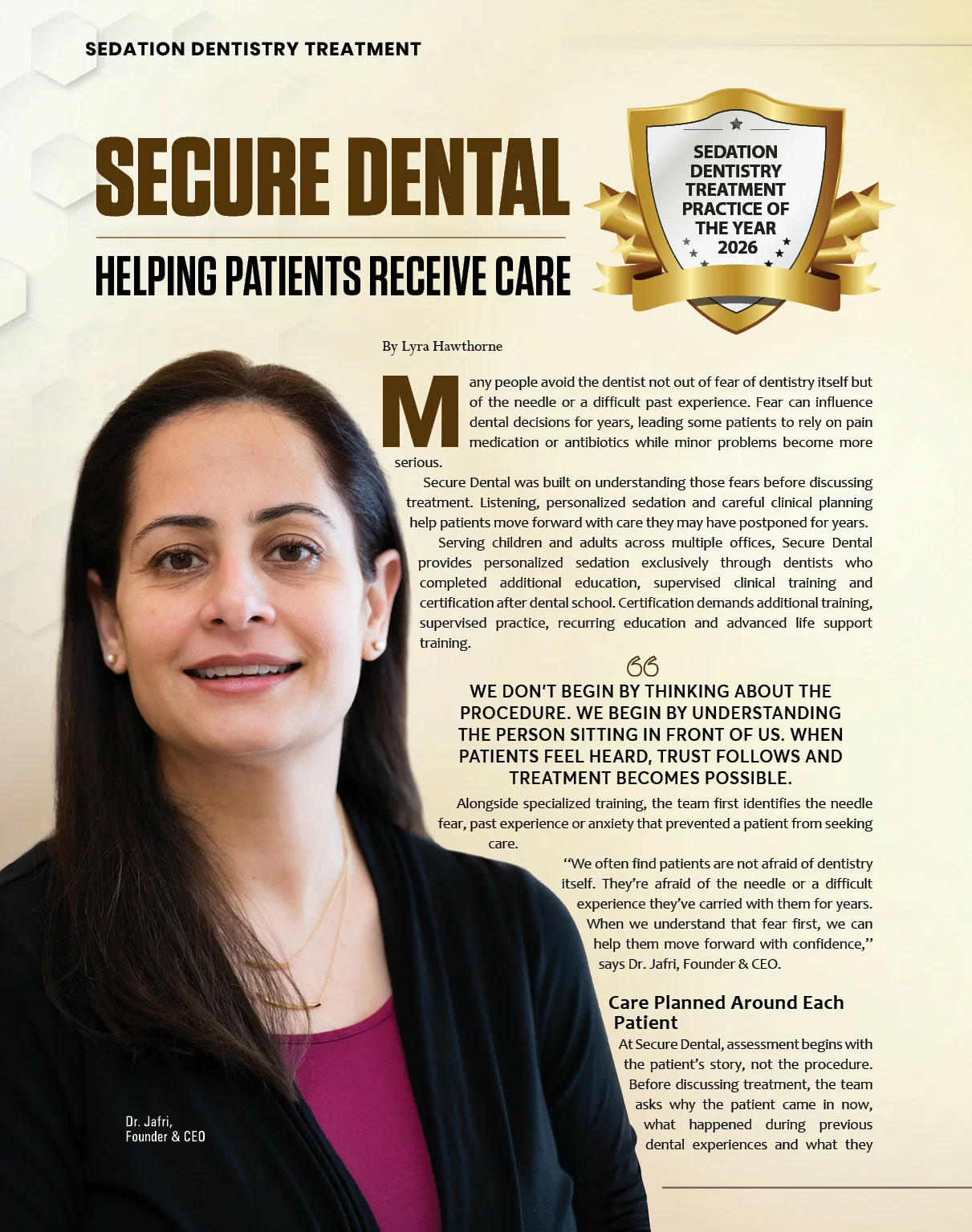
 Dr. Jafri, Founder & CEO
Many people avoid the dentist not out of fear of dentistry itself but of the needle or a difficult past experience. Fear can influence dental decisions for years, leading some patients to rely on pain medication or antibiotics while minor problems become more serious.
Secure Dental was built on understanding those fears before discussing treatment. Listening, personalized sedation and careful clinical planning help patients move forward with care they may have postponed for years.
Serving children and adults across multiple offices, Secure Dental provides personalized sedation exclusively through dentists who completed additional education, supervised clinical training and certification after dental school. Certification demands additional training, supervised practice, recurring education and advanced life support training.
Alongside specialized training, the team first identifies the needle fear, past experience or anxiety that prevented a patient from seeking care.
“We often find patients are not afraid of dentistry itself. They’re afraid of the needle or a difficult experience they’ve carried with them for years. When we understand that fear first, we can help them move forward with confidence,” says Dr. Jafri, Founder & CEO.
Care Planned Around Each Patient
At Secure Dental, assessment begins with the patient’s story, not the procedure. Before discussing treatment, the team asks why the patient came in now, what happened during previous dental experiences and what they fear most. Answers can help explain why someone repeatedly postponed treatment, sought temporary relief through medication or waited until discomfort became unavoidable.
“We don’t begin by thinking about the procedure. We begin by understanding the person sitting in front of us. When patients feel heard, trust follows and treatment becomes possible,” says Dr. Jafri.
Understanding the source of anxiety gives the team context for the clinical evaluation. Cardiac and respiratory health, pregnancy status, allergies, medications, vital signs and weight are reviewed along with other factors that could influence sedation. Emotional concerns and clinical findings are considered together when determining suitable care for each patient.
We often find patients are not afraid of dentistry itself. They're afraid of the needle or a difficult experience they've carried with them for years. When we understand that fear first, we can help them move forward with confidence.
Screening, informed consent, preoperative instructions, fasting guidance and transportation arrangements help patients arrive prepared. Knowing who will be present, what to expect and how anxiety will be managed can reduce some of the uncertainty associated with dental fear.
Communication keeps attention on the life patients hope to regain: smiling comfortably, eating normally and feeling confident again. Avoiding unnecessary procedural detail can help prevent anxiety from building before treatment. Patients who have postponed care for years can focus on a positive result instead of the experience they have feared.
A Practical Example of Change
A 42-year-old woman had avoided significant treatment for six years after a difficult childhood dental experience left her fearful of injections and procedures. Raising her family remained a priority while her own dental care was repeatedly postponed, eventually leaving her in need of extractions and implant planning.
Dr. Jafri first asked why she had chosen to seek care at that point and what had made previous dental visits difficult. Her answers revealed the childhood experience behind the anxiety and provided context for years of avoidance. A review of her medical history, medications, vital signs and overall health followed once the team understood the source of her fear.
Familiar faces helped reduce uncertainty as treatment planning continued. She met the same dentist, treatment coordinator and manager who would be present on treatment day. Conversations kept returning to the result she wanted: eating comfortably, smiling again and regaining confidence. Less attention was placed on details likely to increase fear before the procedure.
Consistency across Every Office
Providing a consistent patient experience across multiple offices requires trained clinicians and repeatable standards. Secure Dental’s sedation-certified dentists maintain their qualifications through recurring continuing education and advanced life support training while remaining connected with DOCS Education. Standardized documentation, clinical protocols and compliance reviews support consistent fear assessment and safety practices from consultation through follow-up.
Clinical protocols evolve with every experience. Teams review outcomes, patient feedback, medication effectiveness and what patients recall after sedation. Dentists discuss what worked, whether medications or dosing need adjustment and whether intake questions could be improved as patient needs and medication use change. Information gathered from individual procedures helps shape future clinical decisions and patient conversations.
Ongoing learning connects each part of Secure Dental’s sedation services. Listening helps uncover the fear that kept a patient away. Specialized certification and medical assessment inform sedation decisions. Positive conversations help patients focus on the life they hope to regain while regular clinical review allows teams to improve future care.
Fear-aware communication, specialized certification, individualized planning, safety processes and continuous learning contributed to Secure Dental’s recognition as Sedation Dentistry Treatment Practice of the Year 2026.
The achievement reflects Secure Dental’s work helping patients overcome longstanding dental fear through listening, personalized sedation and safety measures that support continued oral care.
What Are Sedation Dentistry Treatment Practices, And What Needs Do They Address?
Sedation Dentistry Treatment Practices combine dental care with appropriate methods for reducing anxiety, discomfort, or fear around treatment. The approach can help patients who avoid appointments because of needles, difficult past experiences, or anxiety. Rather than treating sedation as a standalone procedure, Sedation Dentistry Treatment Practices consider the patient's concerns, medical history, planned treatment, and appropriate level of sedation when developing care.
How Does Secure Dental Approach Sedation Dentistry Treatment Practices?
Secure Dental begins with the patient's experience rather than immediately focusing on the procedure. Its team asks what brought the patient in, what happened during previous dental visits, and what the patient fears most. It then reviews factors such as cardiac and respiratory health, pregnancy status, allergies, medications, vital signs, and weight. Secure Dental provides personalized sedation through dentists who have completed additional education, supervised clinical training, certification after dental school, recurring education, and advanced life support training.
What Types Of Care Can Sedation Dentistry Treatment Practices Support?
Sedation Dentistry Treatment Practices can be considered when anxiety or fear makes routine or longer dental care difficult to approach. The appropriate method depends on the patient's needs and the planned appointment. Oral medication or nitrous oxide may support shorter appointments, while IV sedation may be considered for longer or more complex procedures. Careful assessment remains important because sedation is not a one-size-fits-all choice. The goal is to match the care plan to the patient's needs without making sedation the focus of treatment itself.
Why Is Patient Assessment Important Before Sedation?
A structured assessment helps Sedation Dentistry Treatment Practices account for factors that can affect whether sedation is suitable. Screening, informed consent, preoperative instructions, fasting guidance, and transportation arrangements can help patients prepare for treatment. Reviewing health history and current medications also gives the clinical team information needed to plan safely and explain what to expect before, during, and after the appointment.
How Can Sedation Dentistry Treatment Practices Help Patients Move Beyond Dental Fear?
For some patients, Sedation Dentistry Treatment Practices can make it easier to return to care after years of avoidance. Clear communication helps shift the focus toward goals such as eating comfortably, smiling again, and feeling confident about treatment. In one case, a 42-year-old woman had avoided significant treatment for six years after a difficult childhood dental experience. Familiar faces and a consistent treatment plan helped her move forward after the team understood the cause of her anxiety. The case shows that understanding why a patient delays care can be just as important as preparing for the procedure.
What Distinguishes A Patient-Centered Sedation Dentistry Treatment Practice?
A patient-centered Sedation Dentistry Treatment Practice recognizes that anxiety can have different causes and therefore requires individual planning. Secure Dental illustrates this model by serving children and adults across multiple offices and tailoring sedation to the patient's circumstances. Its approach includes identifying the source of fear, reviewing relevant health factors, preparing patients for treatment, and maintaining continuity with familiar members of the care team when possible.
