Thank you for Subscribing to Medical Care Review Weekly Brief


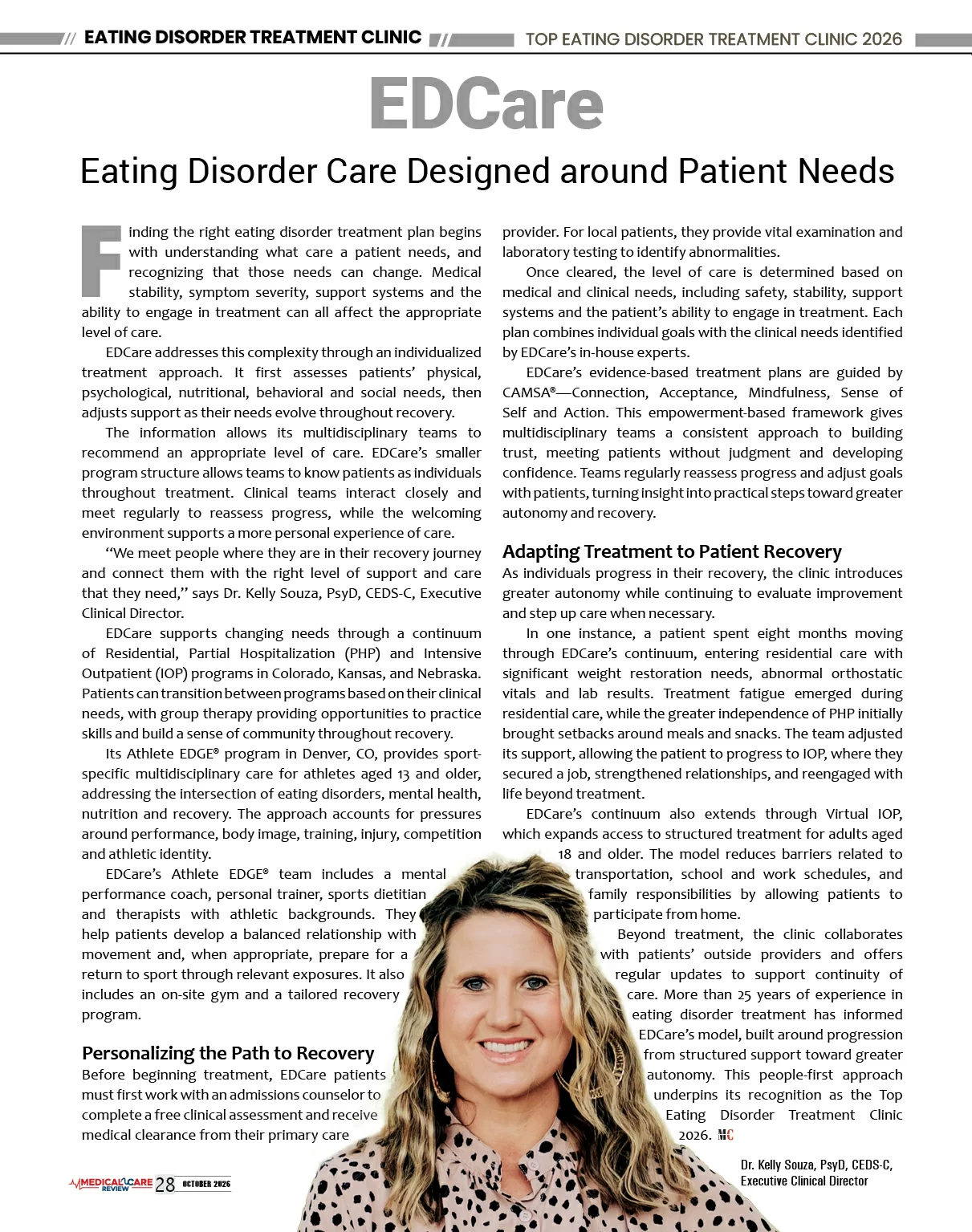
 Dr. Kelly Souza, PsyD, CEDS-C, Executive Clinical Director
Finding the right eating disorder treatment plan begins with understanding what care a patient needs, and recognizing that those needs can change. Medical stability, symptom severity, support systems and the ability to engage in treatment can all affect the appropriate level of care.
EDCare addresses this complexity through an individualized treatment approach. It first assesses patients’ physical, psychological, nutritional, behavioral and social needs, then adjusts support as their needs evolve throughout recovery.
The information allows its multidisciplinary teams to recommend an appropriate level of care. EDCare’s smaller program structure allows teams to know patients as individuals throughout treatment. Clinical teams interact closely and meet regularly to reassess progress, while the welcoming environment supports a more personal experience of care.
“We meet people where they are in their recovery journey and connect them with the right level of support and care that they need,” says Dr. Kelly Souza, PsyD, CEDS-C, Executive Clinical Director.
EDCare supports changing needs through a continuum of Residential, Partial Hospitalization (PHP) and Intensive Outpatient (IOP) programs in Colorado, Kansas, and Nebraska. Patients can transition between programs based on their clinical needs, with group therapy providing opportunities to practice skills and build a sense of community throughout recovery.
Its Athlete EDGE® program in Denver, CO, provides sportspecific multidisciplinary care for athletes aged 13 and older, addressing the intersection of eating disorders, mental health, nutrition and recovery. The approach accounts for pressures around performance, body image, training, injury, competition and athletic identity.
EDCare’s Athlete EDGE® team includes a mental performance coach, personal trainer, sports dietitian and therapists with athletic backgrounds. They help patients develop a balanced relationship with movement and, when appropriate, prepare for a return to sport through relevant exposures. It also includes an on-site gym and a tailored recovery program.
Personalizing the Path to Recovery
Before beginning treatment, EDCare patients must first work with an admissions counselor to complete a free clinical assessment and receive medical clearance from their primary care provider. For local patients, they provide vital examination and laboratory testing to identify abnormalities.
Once cleared, the level of care is determined based on medical and clinical needs, including safety, stability, support systems and the patient’s ability to engage in treatment. Each plan combines individual goals with the clinical needs identified by EDCare’s in-house experts.
EDCare’s evidence-based treatment plans are guided by CAMSA®—Connection, Acceptance, Mindfulness, Sense of Self and Action. This empowerment-based framework gives multidisciplinary teams a consistent approach to building trust, meeting patients without judgment and developing confidence. Teams regularly reassess progress and adjust goals with patients, turning insight into practical steps toward greater autonomy and recovery.
Adapting Treatment to Patient Recovery
As individuals progress in their recovery, the clinic introduces greater autonomy while continuing to evaluate improvement and step up care when necessary.
In one instance, a patient spent eight months moving through EDCare’s continuum, entering residential care with significant weight restoration needs, abnormal orthostatic vitals and lab results. Treatment fatigue emerged during residential care, while the greater independence of PHP initially brought setbacks around meals and snacks. The team adjusted its support, allowing the patient to progress to IOP, where they secured a job, strengthened relationships, and reengaged with life beyond treatment.
EDCare’s continuum also extends through Virtual IOP, which expands access to structured treatment for adults aged 18 and older. The model reduces barriers related to transportation, school and work schedules, and family responsibilities by allowing patients to participate from home.
Beyond treatment, the clinic collaborates with patients’ outside providers and offers regular updates to support continuity of care. More than 25 years of experience in eating disorder treatment has informed EDCare’s model, built around progression from structured support toward greater autonomy. This people-first approach underpins its recognition as the Top Eating Disorder Treatment Clinic 2026.
