Thank you for Subscribing to Medical Care Review Weekly Brief


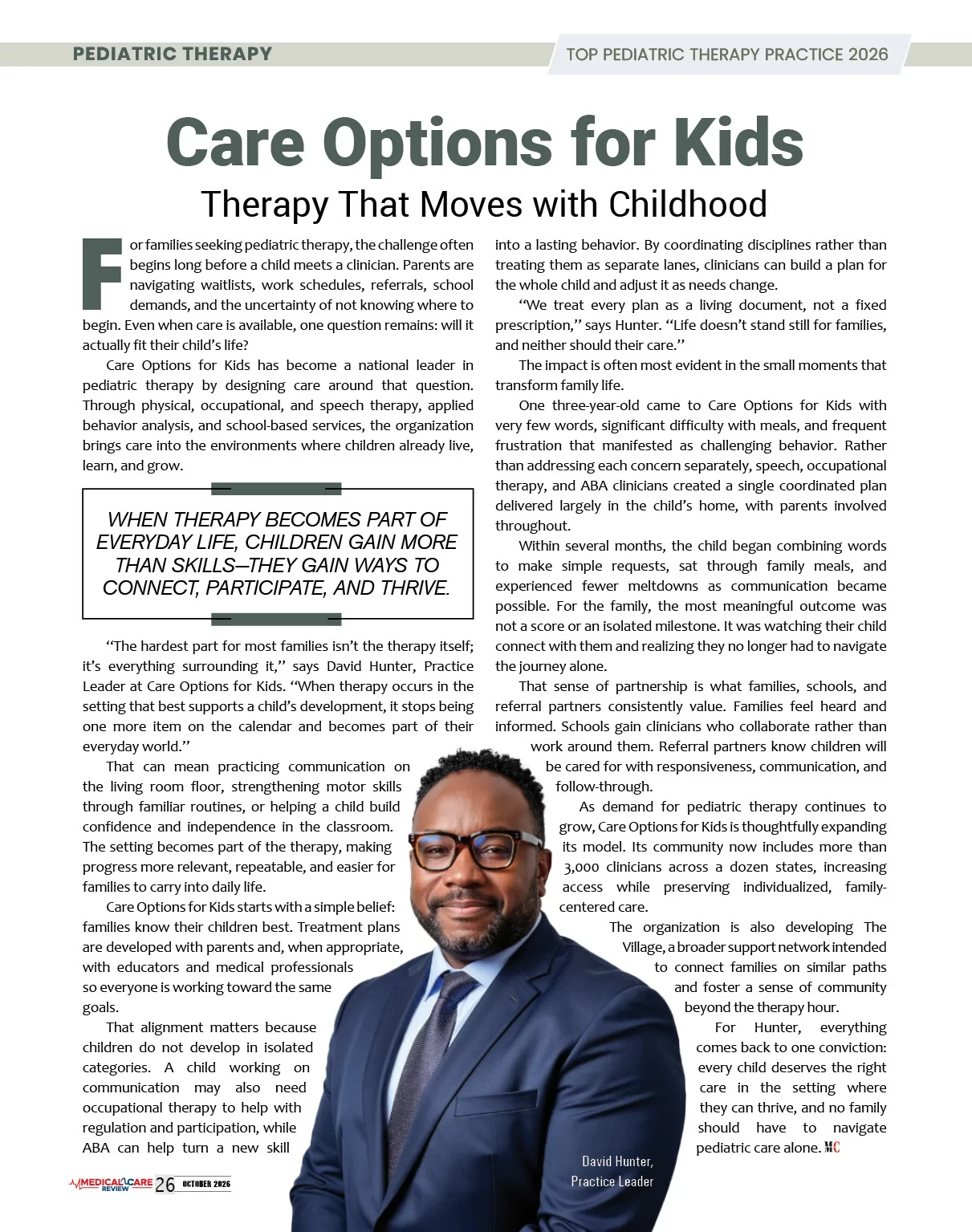
 David Hunter, Practice Leader
For families seeking pediatric therapy, the challenge often begins long before a child meets a clinician. Parents are navigating waitlists, work schedules, referrals, school demands, and the uncertainty of not knowing where to begin. Even when care is available, one question remains: will it actually fit their child’s life?
Care Options for Kidshas become a national leader in pediatric therapy by designing care around that question. Through physical, occupational, and speech therapy, applied behavior analysis, and school-based services, the organization brings care into the environments where children already live, learn, and grow.
“The hardest part for most families isn’t the therapy itself; it’s everything surrounding it,” says David Hunter, Practice Leader at Care Options for Kids. “When therapy occurs in the setting that best supports a child’s development, it stops being one more item on the calendar and becomes part of their everyday world.”
That can mean practicing communication on the living room floor, strengthening motor skills through familiar routines, or helping a child build confidence and independence in the classroom. The setting becomes part of the therapy, making progress more relevant, repeatable, and easier for families to carry into daily life.
Care Options for Kids starts with a simple belief: families know their children best. Treatment plans are developed with parents and, when appropriate, with educators and medical professionals so everyone is working toward the same goals.
That alignment matters because children do not develop in isolated categories. A child working on communication may also need occupational therapy to help with regulation and participation, while ABA can help turn a new skill into a lasting behavior. By coordinating disciplines rather than treating them as separate lanes, clinicians can build a plan for the whole child and adjust it as needs change.
“We treat every plan as a living document, not a fixed prescription,” says Hunter. “Life doesn’t stand still for families, and neither should their care.”
The impact is often most evident in the small moments that transform family life.
One three-year-old came to Care Options for Kids with very few words, significant difficulty with meals, and frequent frustration that manifested as challenging behavior. Rather than addressing each concern separately, speech, occupational therapy, and ABA clinicians created a single coordinated plan delivered largely in the child’s home, with parents involved throughout.
Within several months, the child began combining words to make simple requests, sat through family meals, and experienced fewer meltdowns as communication became possible. For the family, the most meaningful outcome was not a score or an isolated milestone. It was watching their child connect with them and realizing they no longer had to navigate the journey alone.
That sense of partnership is what families, schools, and referral partners consistently value. Families feel heard and informed. Schools gain clinicians who collaborate rather than work around them. Referral partners know children will be cared for with responsiveness, communication, and follow-through.
As demand for pediatric therapy continues to grow, Care Options for Kids is thoughtfully expanding its model. Its community now includes more than 3,000 clinicians across a dozen states, increasing access while preserving individualized, family-centered care.
The organization is also developing The Village, a broader support network intended to connect families on similar paths and foster a sense of community beyond the therapy hour.
For Hunter, everything comes back to one conviction: every child deserves the right care in the setting where they can thrive, and no family should have to navigate pediatric care alone.
