
Thank you for Subscribing to Medical Care Review Weekly Brief


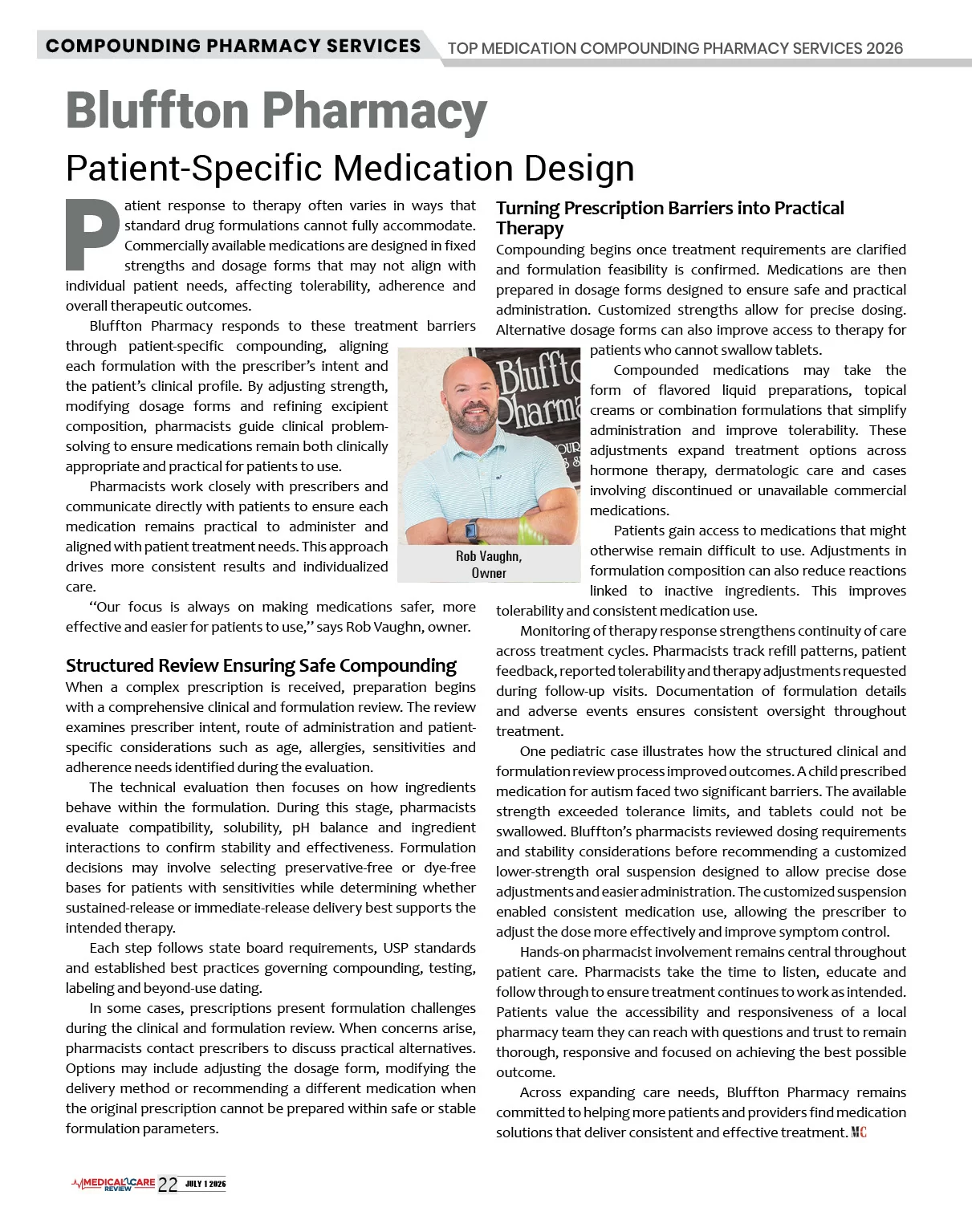
 Rob Vaughn, Owner
Patient response to therapy often varies in ways that standard drug formulations cannot fully accommodate. Commercially available medications are designed in fixed strengths and dosage forms that may not align with individual patient needs, affecting tolerability, adherence and overall therapeutic outcomes.
Bluffton Pharmacy responds to these treatment barriers through patient-specific compounding, aligning each formulation with the prescriber’s intent and the patient’s clinical profile. By adjusting strength, modifying dosage forms and refining excipient composition, pharmacists guide clinical problem-solving to ensure medications remain both clinically appropriate and practical for patients to use.
Pharmacists work closely with prescribers and communicate directly with patients to ensure each medication remains practical to administer and aligned with patient treatment needs. This approach drives more consistent results and individualized care.
“Our focus is always on making medications safer, more effective and easier for patients to use,” says Rob Vaughn, owner.
Structured Review Ensuring Safe Compounding
When a complex prescription is received, preparation begins with a comprehensive clinical and formulation review. The review examines prescriber intent, route of administration and patient-specific considerations such as age, allergies, sensitivities and adherence needs identified during the evaluation.
The technical evaluation then focuses on how ingredients behave within the formulation. During this stage, pharmacists evaluate compatibility, solubility, pH balance and ingredient interactions to confirm stability and effectiveness. Formulation decisions may involve selecting preservative-free or dye-free bases for patients with sensitivities while determining whether sustained-release or immediate-release delivery best supports the intended therapy.
Each step follows state board requirements, USP standards and established best practices governing compounding, testing, labeling and beyond-use dating.
In some cases, prescriptions present formulation challenges during the clinical and formulation review. When concerns arise, pharmacists contact prescribers to discuss practical alternatives. Options may include adjusting the dosage form, modifying the delivery method or recommending a different medication when the original prescription cannot be prepared within safe or stable formulation parameters.
Turning Prescription Barriers into Practical Therapy
Compounding begins once treatment requirements are clarified and formulation feasibility is confirmed. Medications are then prepared in dosage forms designed to ensure safe and practical administration. Customized strengths allow for precise dosing. Alternative dosage forms can also improve access to therapy for patients who cannot swallow tablets.
Compounded medications may take the form of flavored liquid preparations, topical creams or combination formulations that simplify administration and improve tolerability. These adjustments expand treatment options across hormone therapy, dermatologic care and cases involving discontinued or unavailable commercial medications.
Patients gain access to medications that might otherwise remain difficult to use. Adjustments in formulation composition can also reduce reactions linked to inactive ingredients. This improves tolerability and consistent medication use.
Monitoring of therapy response strengthens continuity of care across treatment cycles. Pharmacists track refill patterns, patient feedback, reported tolerability and therapy adjustments requested during follow-up visits. Documentation of formulation details and adverse events ensures consistent oversight throughout treatment.
One pediatric case illustrates how the structured clinical and formulation review process improved outcomes. A child prescribed medication for autism faced two significant barriers. The available strength exceeded tolerance limits, and tablets could not be swallowed. Bluffton’s pharmacists reviewed dosing requirements and stability considerations before recommending a customized lower-strength oral suspension designed to allow precise dose adjustments and easier administration. The customized suspension enabled consistent medication use, allowing the prescriber to adjust the dose more effectively and improve symptom control.
Hands-on pharmacist involvement remains central throughout patient care. Pharmacists take the time to listen, educate and follow through to ensure treatment continues to work as intended. Patients value the accessibility and responsiveness of a local pharmacy team they can reach with questions and trust to remain thorough, responsive and focused on achieving the best possible outcome.
Across expanding care needs, Bluffton Pharmacy remains committed to helping more patients and providers find medication solutions that deliver consistent and effective treatment.
What Are Medication Compounding Pharmacy Services?
Not every patient can take a standard manufactured medication as it is. Medication Compounding Pharmacy Services involve creating customized prescriptions based on a patient's specific dosage, ingredient needs or preferred method of delivery. This approach can be helpful when commercially available medications do not fully meet individual requirements. Medication Compounding Pharmacy Services are often used to adjust strengths, combine ingredients or remove components that may cause sensitivities.
How Does Bluffton Pharmacy Approach Personalized Prescriptions?
Many patients need medications that are tailored to their specific circumstances rather than a standard solution. Bluffton Pharmacy has built a strong reputation for putting patients first while offering compounded medications as part of its services. Located in Bluffton, South Carolina, the pharmacy combines prescription dispensing with pharmacist guidance and customized medication preparation when needed. Its local, patient-focused approach makes Medication Compounding Pharmacy Services more convenient and accessible for those who value personalized care, direct communication and ongoing support throughout their treatment.
When Should Patients Consider Compounded Medications?
Compounded medications may be considered when a patient needs a different dosage strength, an alternative dosage form or an ingredient adjustment recommended by a healthcare provider. In many situations, the issue is not the medication itself but how it is formulated or delivered. Medication Compounding Pharmacy Services help address those needs by creating prescriptions that better fit a patient's treatment plan while maintaining proper pharmacist oversight and prescription requirements.
What Quality Factors Matter When Evaluating a Compounding Pharmacy?
Accuracy, consistency and clear communication are key factors to consider. Patients should ask how prescriptions are reviewed, where ingredients come from and what quality measures are in place during preparation. Medication Compounding Pharmacy Services depend on precise processes because even small differences can affect treatment outcomes. Strong collaboration between pharmacists, prescribers and patients often reflects a pharmacy's commitment to delivering truly personalized care.
How Do Medication Compounding Pharmacy Services Improve the Patient Experience?
Following a medication routine can be difficult when standard products do not meet a patient's needs. Customized formulations may help remove barriers that make it harder to stay on track with treatment plans. Medication Compounding Pharmacy Services focus on adapting medications to the patient rather than limiting patients to a standard set of options. This flexibility can make treatment easier to manage, especially for those taking medications over an extended period.
Why Is Bluffton Pharmacy Recognized Among Medication Compounding Pharmacy Providers?
Recognition often comes from a combination of personalized service, pharmacy expertise and community trust. Bluffton Pharmacy's inclusion among leading providers reflects its focus on individualized prescription support and patient-centered care. Beyond compounding, it serves as a full-service community pharmacy that helps patients manage prescriptions, address medication concerns and navigate ongoing healthcare needs. These qualities are often what patients look for when choosing Medication Compounding Pharmacy Services that value both customization and accessibility.
