
Thank you for Subscribing to Medical Care Review Weekly Brief


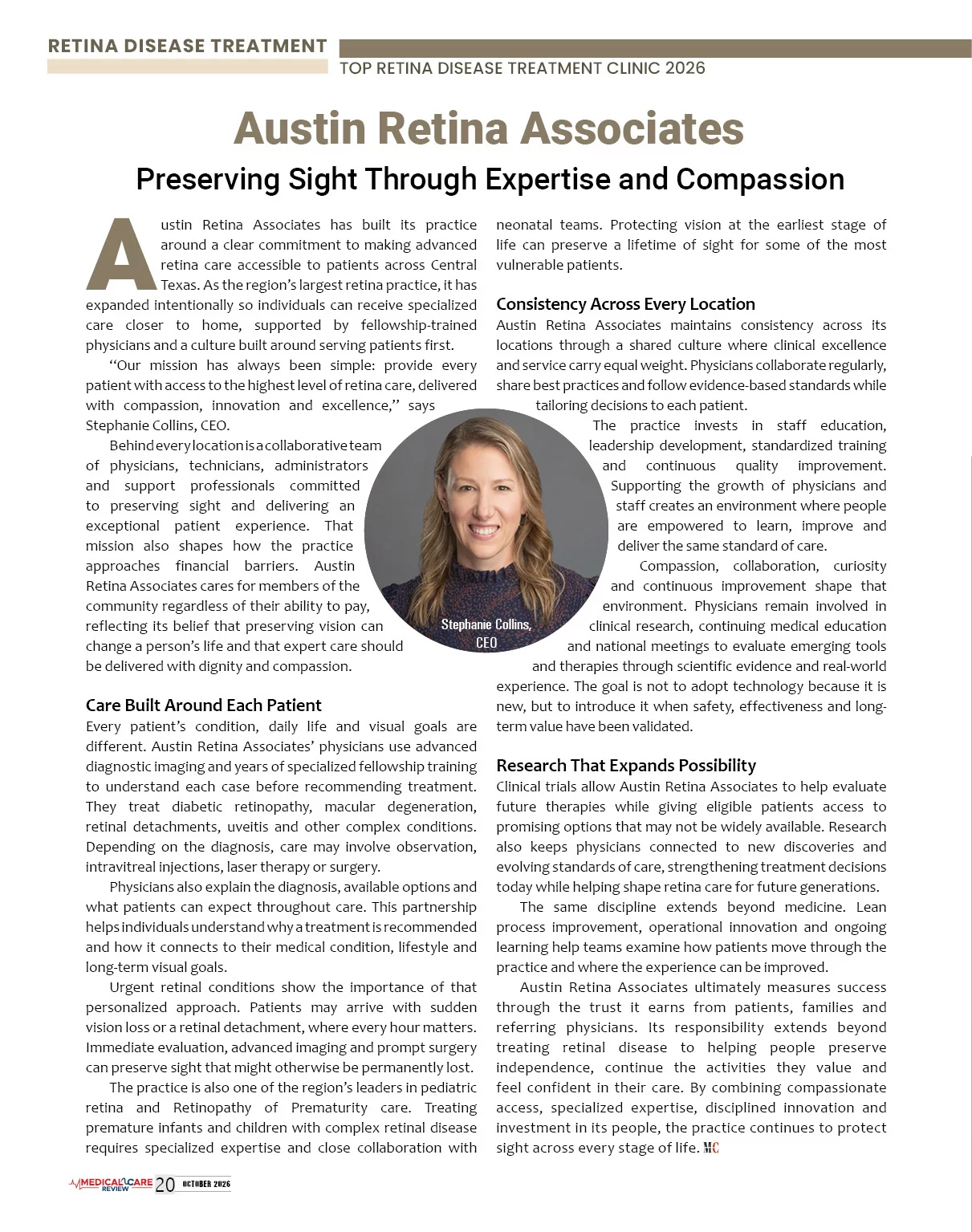
 Stephanie Collins, CEO
Austin Retina Associates has built its practice around a clear commitment to making advanced retina care accessible to patients across Central Texas. As the region’s largest retina practice, it has expanded intentionally so individuals can receive specialized care closer to home, supported by fellowship-trained physicians and a culture built around serving patients first.
“Our mission has always been simple: provide every patient with access to the highest level of retina care, delivered with compassion, innovation and excellence,” says Stephanie Collins, CEO.
Behind every location is a collaborative team of physicians, technicians, administrators and support professionals committed to preserving sight and delivering an exceptional patient experience. That mission also shapes how the practice approaches financial barriers. Austin Retina Associates cares for members of the community regardless of their ability to pay, reflecting its belief that preserving vision can change a person’s life and that expert care should be delivered with dignity and compassion.
Care Built Around Each Patient
Every patient’s condition, daily life and visual goals are different. Austin Retina Associates’ physicians use advanced diagnostic imaging and years of specialized fellowship training to understand each case before recommending treatment. They treat diabetic retinopathy, macular degeneration, retinal detachments, uveitis and other complex conditions. Depending on the diagnosis, care may involve observation, intravitreal injections, laser therapy or surgery.
Physicians also explain the diagnosis, available options and what patients can expect throughout care. This partnership helps individuals understand why a treatment is recommended and how it connects to their medical condition, lifestyle and long-term visual goals.
Urgent retinal conditions show the importance of that personalized approach. Patients may arrive with sudden vision loss or a retinal detachment, where every hour matters. Immediate evaluation, advanced imaging and prompt surgery can preserve sight that might otherwise be permanently lost.
The practice is also one of the region’s leaders in pediatric retina and Retinopathy of Prematurity care. Treating premature infants and children with complex retinal disease requires specialized expertise and close collaboration with neonatal teams. Protecting vision at the earliest stage of life can preserve a lifetime of sight for some of the most vulnerable patients.
Consistency Across Every Location
Austin Retina Associates maintains consistency across its locations through a shared culture where clinical excellence and service carry equal weight. Physicians collaborate regularly, share best practices and follow evidence-based standards while tailoring decisions to each patient.
Compassion, collaboration, curiosity and continuous improvement shape that environment. Physicians remain involved in clinical research, continuing medical education and national meetings to evaluate emerging tools and therapies through scientific evidence and real-world experience. The goal is not to adopt technology because it is new, but to introduce it when safety, effectiveness and long-term value have been validated.
Research That Expands Possibility
Clinical trials allow Austin Retina Associates to help evaluate future therapies while giving eligible patients access to promising options that may not be widely available. Research also keeps physicians connected to new discoveries and evolving standards of care, strengthening treatment decisions today while helping shape retina care for future generations.
The same discipline extends beyond medicine. Lean process improvement, operational innovation and ongoing learning help teams examine how patients move through the practice and where the experience can be improved.
Austin Retina Associates ultimately measures success through the trust it earns from patients, families and referring physicians. Its responsibility extends beyond treating retinal disease to helping people preserve independence, continue the activities they value and feel confident in their care. By combining compassionate access, specialized expertise, disciplined innovation and investment in its people, the practice continues to protect sight across every stage of life.
What Does a Retina Disease Treatment Clinic Provide?
A Retina Disease Treatment Clinic focuses on diagnosing and treating conditions affecting the retina, vitreous and macula. Care can encompass diagnostic testing, medical treatment and retinal surgery, depending on the condition involved. Common areas include diabetic retinopathy, age-related macular degeneration, retinal vein occlusion, macular holes, epiretinal membranes, uveitis, and retinal tears or detachments. A specialized setting brings these conditions under the care of physicians trained specifically in vitreoretinal medicine and surgery.
How Does Austin Retina Associates Approach Retinal Care?
Austin Retina Associates provides specialized care through board-certified ophthalmologists who are fellowship-trained retinal specialists and surgeons. Its physicians manage diseases involving the retina, vitreous and macula, while its diagnostic centers use advanced diagnostic equipment and surgical procedures. The practice has been providing specialized retina care for more than 40 years and serves Central Texas through multiple locations.
Which Conditions Can Retina Disease Treatment Clinics Manage?
The scope of a Retina Disease Treatment Clinic can extend across both common and complex retinal disorders. Depending on the clinical need, care may address diabetic eye disease, macular degeneration, retinal holes, tears and detachments, retinal vein occlusion, choroidal melanoma, macular holes and uveitis. Pediatric retinal conditions such as retinopathy of prematurity are also part of the treatment landscape. The appropriate approach depends on the specific diagnosis and findings from retinal evaluation.
What Should Patients Look For In Specialized Retina Care?
When evaluating a Retina Disease Treatment Clinic, patients can consider the breadth of conditions treated, the qualifications of the physicians and access to diagnostic and surgical capabilities. Fellowship training in retinal medicine and surgery is one relevant qualification. Diagnostic technology is also important because detailed assessment can help physicians determine the nature and extent of retinal disease. Accessibility can matter as well, particularly when ongoing monitoring or repeated treatment is required.
How Can A Retina Disease Treatment Clinic Support Complex Treatment Needs?
Retinal disorders can require different forms of intervention over time, making continuity of specialized care important. A Retina Disease Treatment Clinic may combine diagnostic evaluation, medical treatment and surgical procedures according to the condition. Austin Retina Associates operates 11 locations across Central Texas, with centers extending from the greater Austin area to communities including Waco and San Marcos. Its specialists also provide 24/7 doctor availability, supporting access when urgent retinal concerns arise.
Why Is Specialized Expertise Important In Retina Disease Treatment?
The retina contains structures central to vision, so retinal disease can require highly focused evaluation and treatment. A Retina Disease Treatment Clinic provides access to physicians whose training is dedicated to vitreoretinal conditions. Austin Retina Associates reports more than 226 years of combined retina experience among its physicians and more than 3,000 sight-saving treatments completed each month on average. This specialized model can support care across a broad range of retinal and macular conditions.
