
Thank you for Subscribing to Medical Care Review Weekly Brief


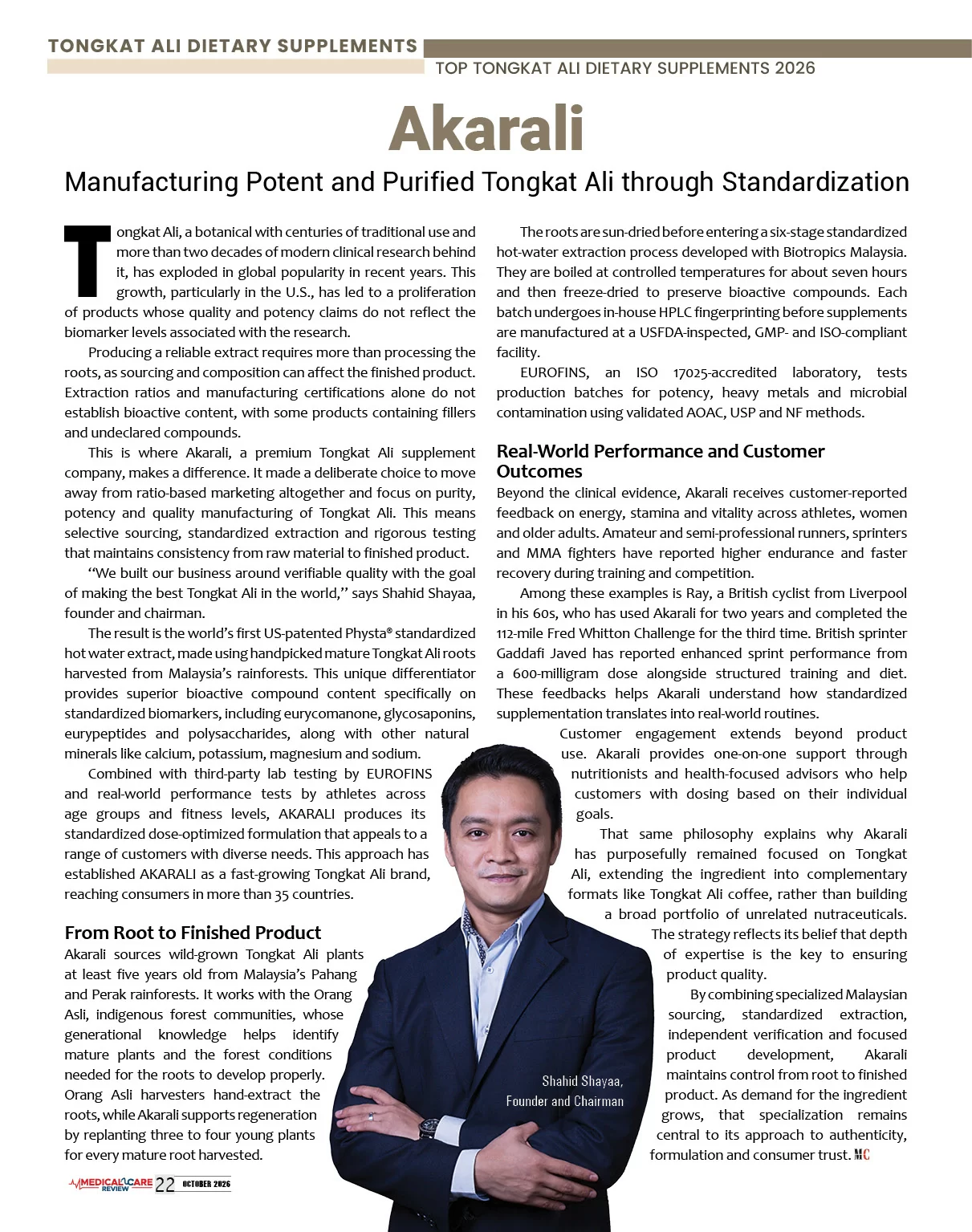
 Shahid Shayaa, Founder and Chairman
Tongkat Ali, a botanical with centuries of traditional use and more than two decades of modern clinical research behind it, has exploded in global popularity in recent years. This growth, particularly in the U.S., has led to a proliferation of products whose quality and potency claims do not reflect the biomarker levels associated with the research.
Producing a reliable extract requires more than processing the roots, as sourcing and composition can affect the finished product. Extraction ratios and manufacturing certifications alone do not establish bioactive content, with some products containing fillers and undeclared compounds.
This is where Akarali, a premium Tongkat Ali supplement company, makes a difference. It made a deliberate choice to move away from ratio-based marketing altogether and focus on purity, potency and quality manufacturing of Tongkat Ali. This means selective sourcing, standardized extraction and rigorous testing that maintains consistency from raw material to finished product.
“We built our business around verifiable quality with the goal of making the best Tongkat Ali in the world,” says Shahid Shayaa, founder and chairman.
The result is the world’s first US-patented Physta® standardized hot water extract, made using handpicked mature Tongkat Ali roots harvested from Malaysia’s rainforests. This unique differentiator provides superior bioactive compound content specifically on standardized biomarkers, including eurycomanone, glycosaponins, eurypeptides and polysaccharides, along with other natural minerals like calcium, potassium, magnesium and sodium.
Combined with third-party lab testing by EUROFINS and real-world performance tests by athletes across age groups and fitness levels, AKARALI produces its standardized dose-optimized formulation that appeals to a range of customers with diverse needs. This approach has established AKARALI as a fast-growing Tongkat Ali brand, reaching consumers in more than 35 countries.
From Root to Finished Product
Akarali sources wild-grown Tongkat Ali plants at least five years old from Malaysia’s Pahang and Perak rainforests. It works with the Orang Asli, indigenous forest communities, whose generational knowledge helps identify mature plants and the forest conditions needed for the roots to develop properly. Orang Asli harvesters hand-extract the roots, while Akarali supports regeneration by replanting three to four young plants for every mature root harvested.
The roots are sun-dried before entering a six-stage standardized hot-water extraction process developed with Biotropics Malaysia. They are boiled at controlled temperatures for about seven hours and then freeze-dried to preserve bioactive compounds. Each batch undergoes in-house HPLC fingerprinting before supplements are manufactured at a USFDA-inspected, GMP- and ISO-compliant facility.
EUROFINS, an ISO 17025-accredited laboratory, tests production batches for potency, heavy metals and microbial contamination using validated AOAC, USP and NF methods.
Real-World Performance and Customer Outcomes
Beyond the clinical evidence, Akarali receives customer-reported feedback on energy, stamina and vitality across athletes, women and older adults. Amateur and semi-professional runners, sprinters and MMA fighters have reported higher endurance and faster recovery during training and competition.
Among these examples is Ray, a British cyclist from Liverpool in his 60s, who has used Akarali for two years and completed the 112-mile Fred Whitton Challenge for the third time. British sprinter Gaddafi Javed has reported enhanced sprint performance from a 600-milligram dose alongside structured training and diet. These feedbacks helps Akarali understand how standardized supplementation translates into real-world routines.
Customer engagement extends beyond product use. Akarali provides one-on-one support through nutritionists and health-focused advisors who help customers with dosing based on their individual goals.
That same philosophy explains why Akarali has purposefully remained focused on Tongkat Ali, extending the ingredient into complementary formats like Tongkat Ali coffee, rather than building a broad portfolio of unrelated nutraceuticals. The strategy reflects its belief that depth of expertise is the key to ensuring product quality.
By combining specialized Malaysian sourcing, standardized extraction, independent verification and focused product development, Akarali maintains control from root to finished product. As demand for the ingredient grows, that specialization remains central to its approach to authenticity, formulation and consumer trust.
What Are Tongkat Ali Dietary Supplements, and What Should Buyers Understand About Them?
Tongkat Ali Dietary Supplements are formulations made from Eurycoma longifolia, a botanical traditionally associated with vitality and performance. Product quality can vary because sourcing, extraction and standardization affect the composition of the finished extract. Buyers should look beyond simple extraction ratios and consider whether a product identifies measurable bioactive compounds, uses controlled processing and provides credible testing for potency and contaminants. Clear labeling and transparent quality controls make it easier to compare formulations on substance rather than marketing language.
How Does Akarali Approach Tongkat Ali Dietary Supplements?
Akarali approaches Tongkat Ali Dietary Supplements through controlled sourcing, standardized extraction and batch-level verification. It uses mature, wild-grown Tongkat Ali roots harvested from Malaysia’s Pahang and Perak rainforests and processes them through a standardized hot-water extraction method developed with Biotropics Malaysia. The resulting Physta extract is US-patented. Production batches also undergo in-house HPLC fingerprinting and independent EUROFINS testing for potency, heavy metals and microbial contamination before finished supplements reach customers.
Why Does Standardization Matter in Tongkat Ali Formulations?
For Tongkat Ali Dietary Supplements, standardization helps establish whether important bioactive compounds remain consistent from batch to batch. An extraction ratio alone does not confirm the concentration or profile of those compounds. More useful evaluation points include defined biomarkers, validated testing methods and repeatable manufacturing steps. These controls help users understand what is actually present in a formulation and reduce reliance on broad potency claims. Standardization therefore serves as a practical quality benchmark when comparing extracts intended for consistent use.
What Quality Factors Matter When Evaluating a Tongkat Ali Supplement?
Tongkat Ali Dietary Supplements should be assessed through a combination of ingredient traceability, extraction controls, contaminant testing and manufacturing standards. Buyers can examine where the roots come from, whether the extract is standardized, how batches are tested and whether the production facility follows recognized quality systems. Independent laboratory verification can add another layer of confidence by checking potency and screening for heavy metals or microbial contamination. A transparent testing framework is particularly useful in a category where product composition may differ substantially.
How Does Akarali Maintain Control From Root Sourcing to Finished Product?
Akarali supports Tongkat Ali Dietary Supplements with a process that begins before extraction. It sources plants at least five years old and works with Orang Asli harvesters who identify mature roots in Malaysian rainforest environments. The roots are sun-dried, processed through a six-stage hot-water extraction cycle and freeze-dried to preserve their bioactive profile. Manufacturing takes place at a USFDA-inspected, GMP- and ISO-compliant facility, while Akarali also provides one-on-one dosing support through nutritionists and health-focused advisors.
How Can Buyers Compare Different Tongkat Ali Products More Effectively?
Comparing Tongkat Ali Dietary Supplements is easier when buyers focus on verifiable product information rather than a single headline number. Useful questions include whether the botanical source is disclosed, whether the extract is standardized to identified biomarkers, whether independent testing covers both potency and contaminants and whether manufacturing controls are documented. Buyers should also review serving information and product guidance carefully. Taken together, these factors provide a more complete basis for comparing formulation quality, consistency and transparency across available options.
